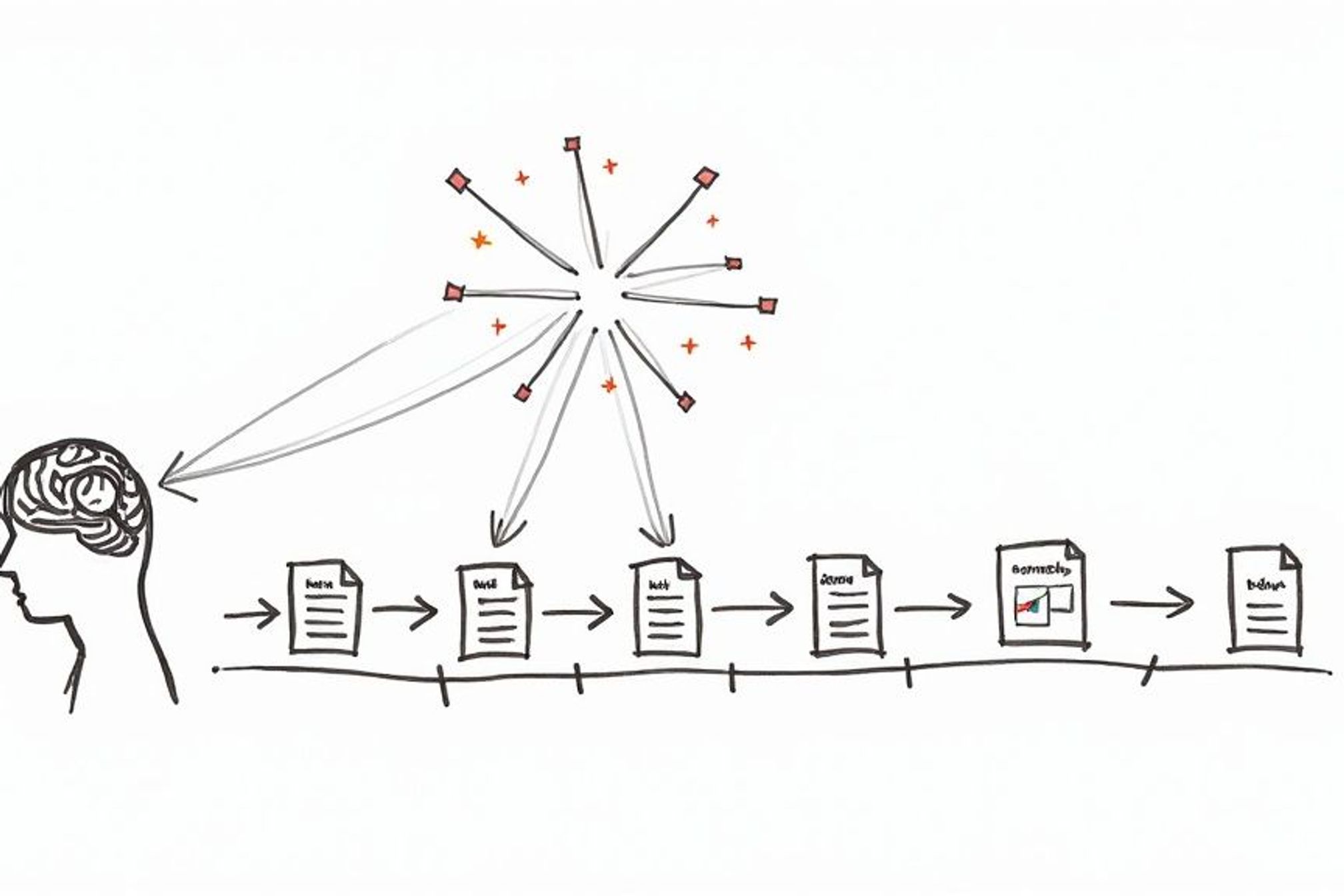
Here’s the simple truth: AI Overviews don't pull sources out of thin air. They lean heavily on pages that already rank at the top of Google’s classic search results.
Think of it as a smart filter. The AI trusts Google's existing judgment, picking from pages the search engine has already marked as helpful and relevant to create a quick summary for you.
What Are AI Overviews and How Do They Work
Imagine asking a super-smart research assistant a question. Instead of just handing you a stack of articles to read through, they read the best ones for you and give you a single, easy-to-understand answer right away.
That's exactly what an AI Overview does. When you type a question into Google, this AI feature scans the top-ranking web pages on that topic. It then pulls the most important information from these different sources into a short summary that appears right at the top of the results page.
The whole point is to get you answers faster, saving you the trouble of clicking through multiple links. This infographic breaks down the basic flow from your question to the AI's answer.
As you can see, the AI’s first move is to scan existing, high-quality content before it even starts building its summary. This makes your regular search ranking very important.
The Secret Isn't So Secret
While Google hasn't published the exact rules for how AI Overviews choose sources, the evidence is pretty clear. Experts and data both point to the fact that the AI heavily relies on Google's existing search rankings.
Google has not shared its exact formula for how AI Overviews rank sources. However, we assume it's similar to the regular search system. The AI likely finds the best-ranking pages and summarizes their content.
This means the AI isn’t looking for random blogs; it’s looking for pages that Google already trusts. It's why basic SEO is still the name of the game. Your website has to earn a high rank in the traditional search results to even have a chance to be included in an AI Overview.
The process is quite similar to understanding how websites appear in ChatGPT responses, where being a trusted source plays a key role.
Let’s walk through a simplified version of what’s happening behind the scenes.
From Your Question to an AI Answer
This table gives a simplified step-by-step look at how AI Overviews create a summary from your search query.
Step | What Happens | Why It Matters for Your Website |
|---|---|---|
1. User Asks | Someone types a question into Google. | Your content needs to answer real questions your audience has. |
2. AI Scans | top-ranking | If you're not on page one, you're likely not in the running. |
3. Information Extraction | It pulls key facts, numbers, and answers from multiple trusted sources. | Your content must be clear, well-organized, and factually correct. |
4. Synthesis | The AI combines the information into a single, easy-to-read summary. | Your unique ideas or data make your content more valuable for summaries. |
5. Citation & Display | The final AI Overview is shown, often with links to the source pages. | Being cited drives direct traffic and builds your brand's reputation. |
Ultimately, this shows that the path to being featured starts with creating content that search engines already love. By focusing on solid SEO principles, you're also putting your site in the best possible position to be featured in these new AI-powered summaries.
The Core Signals That Guide AI Source Selection
So, how does Google's AI decide which web pages are the best sources for its summaries? While Google hasn't shared the exact recipe, we can make a good guess. The AI likely follows the same core principles that have driven regular search rankings for years.
What does that mean for you? It means good, basic SEO is still your best bet. Because AI Overviews likely pull from the highest-ranking pages, your existing rank in Google is more important than ever. This is why having a strong SEO foundation is key.
The Foundation of Trust: E-E-A-T
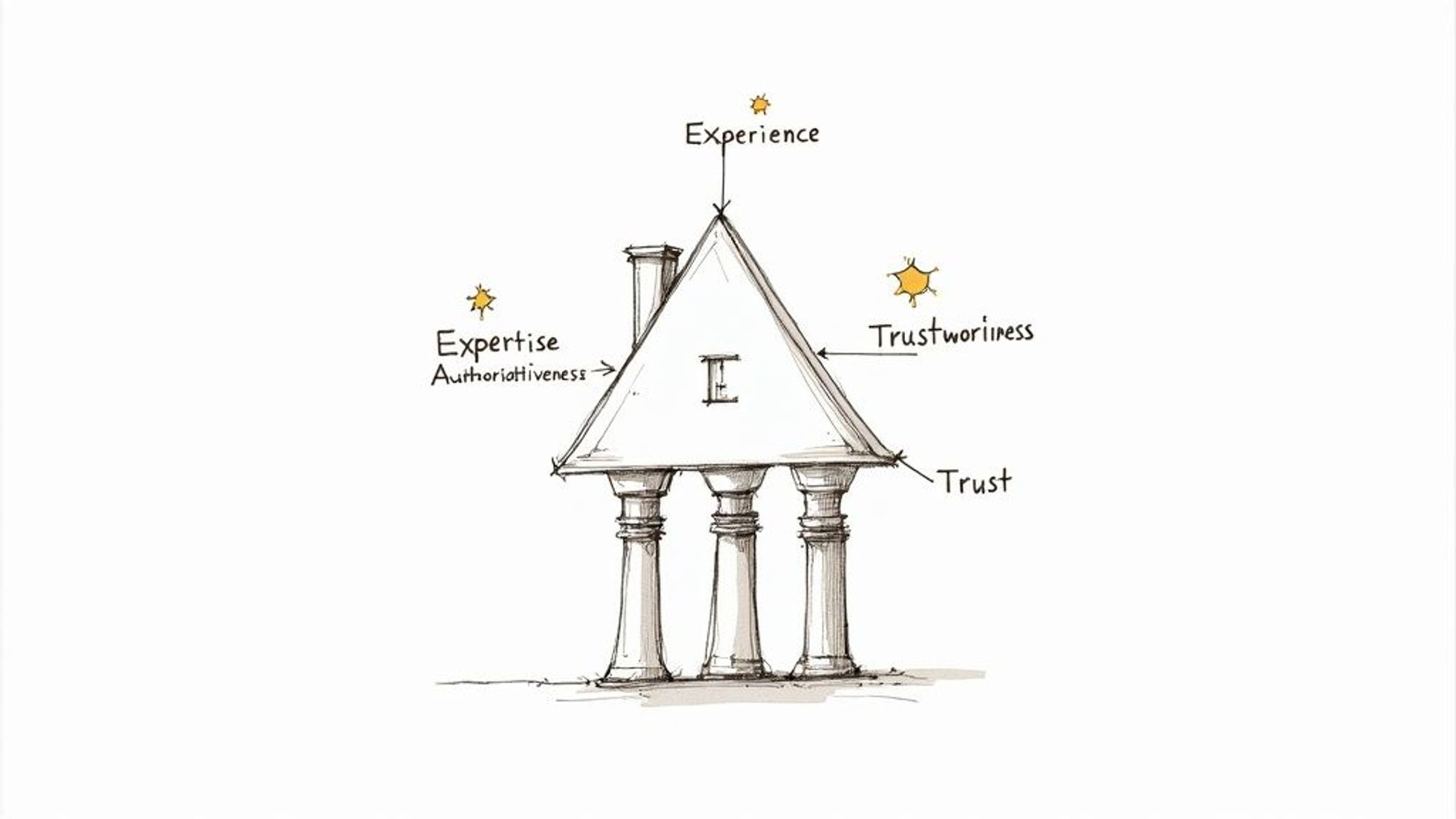
Think of getting your website chosen as a source like building a house. You can't just throw up the walls; you need a rock-solid foundation. For Google, that foundation is a concept called E-E-A-T.
It’s a name that stands for:
- Experience: The content shows you've actually done the thing you're writing about.
- Expertise: The author is a real expert on the subject.
- Authoritativeness: Other respected sources point to your site as a go-to resource.
- Trustworthiness: Your site is secure, reliable, and has a good reputation.
For example, when searching for medical advice, the AI will prefer information from a well-known hospital's website over a random personal blog. Why? The hospital has a long track record of expertise and trustworthiness, making it a reliable source. The same logic applies to financial advice or even understanding the various factors that influence ChatGPT's rankings, where being credible is everything.
The core idea is simple: Google's AI needs to trust your content before it recommends it to millions of users. Proving your site is a reliable and expert voice is the first and most important step.
How AI Systems Process and Rank Content
Beyond general trustworthiness, AI systems use special methods to make sense of what they read. Understanding how these systems sort and categorize information is key to grasping how they analyze content.
This technology is a big deal. The market for AI that gathers news and information is exploding, and is expected to be worth $15 billion by 2025. This incredible growth shows just how much demand there is for tools that can quickly filter content for reliability. These tools use complex computer programs to decide which sources are most relevant and dependable, a process that is similar to what's happening inside AI Overviews.
Why Your SEO Efforts Are Now More Important Than Ever
With AI changing the search page, it’s fair to ask if old-school SEO still matters. The answer is a loud and clear yes—in fact, it’s more important than ever before.
Think of it this way: AI Overviews are like a VIP party, and a high Google ranking is your exclusive invitation.
Google has not published its exact ranking algorithm for AI Overviews. However, all signs suggest that the AI pulls information from the best-ranking pages and summarizes it. If your website isn't on the first page for a particular search, it has almost no chance of being chosen as a source. This is why basic SEO is still very important.
This means your current SEO work isn't going to waste. It’s the most direct path to becoming a trusted source for AI Overviews.
SEO Is Your Ticket to the AI Game
Your basic SEO practices are now the foundation for getting seen by both the regular search engine and the AI. To really get why this matters so much now, it helps to start with the fundamental importance of SEO in the first place.
Here are the key areas that matter most:
- Answer Questions Directly: Shape your content to clearly and simply answer a specific question. AI systems are built to find direct answers, so making your information easy to grab gives you a big advantage.
- Use Keywords Naturally: Place keywords where they make sense, almost like you’re having a normal conversation. Don't force them in. The idea is to show what your page is about in a helpful, human way.
- Make Your Site Mobile-Friendly: A huge number of searches happen on phones. If your site is slow or hard to use on a small screen, Google will notice, and it will hurt your chances of ranking well.
Your SEO efforts are no longer just about climbing the ten blue links. They are about creating a strong, trusted presence that Google's AI will see as a good source to feature at the very top of its results.
At the end of the day, you need a solid SEO strategy to get your content in front of the AI. For a deeper look, check out our guide on how to rank in AI search results. The core principles haven't changed—they've just become a whole lot more important.
Creating Content That AI Overviews Prefer

So, what does it actually take to create "high-quality content" in the age of AI? It’s no longer about just adding the right keywords. Today’s AI systems are much smarter—they can genuinely tell how helpful a page is, not just the words written on it.
Think of your content like a top student's essay. It needs a logical structure with clear headings, brings fresh ideas or data to the table, and clearly "shows its work" by linking out to other credible sources. This kind of organization makes it very easy for an AI to scan your page and pull out the most valuable pieces of information.
Bottom line: The content that wins a spot in AI Overviews is almost always well-structured, packed with unique insights, and kept up-to-date. These are the practical traits AI is built to look for.
Making Your Content a Go-To Resource
To get your content treated like a go-to source, you need to deliver information that feels both unique and solid. Including specific, hard-to-find details is a powerful signal to both people and search engines that your content is well-researched and trustworthy.
Here are a few ways to do just that:
- Include Unique Data: Add your own statistics, survey results, or original research that isn't found on a dozen other sites.
- Use Fresh Examples: Explain your points with current, real-world examples that make complex ideas easy to understand.
- Quote Experts: Add quotes from recognized experts in your field to give your content more weight and credibility.
When you follow these tips, you stop writing for a machine and start creating a genuinely useful resource that people will love. That, in turn, is a core part of learning how to get featured in AI Overviews.
The goal is to make your content so useful that the AI sees it as a primary source for building its summary. Fresh perspectives and hard data are your best friends here.
As AI becomes more a part of our daily lives, it’s also getting more attention from governments. Globally, government focus on AI has shot up by 21.3% since 2023, showing a clear push for more openness in how these systems work.
According to the latest AI Index report from Stanford, overview tools tend to favor content based on credibility signals like a publication's reputation and how often it’s cited elsewhere. This just goes to show why building a trustworthy online presence is more critical now than ever before.
The Bigger Picture of AI in Search
AI-powered summaries aren't just a shiny new feature—they represent a major change in how we all find information online. Across the globe, these systems are busy processing huge amounts of data, trying to figure out what content is credible, relevant, and genuinely helpful.
This technology is spreading very quickly, which puts a lot of pressure on search engines to get it right. One of the biggest challenges is removing wrong information, and that's exactly why Google is leaning so heavily on its long-standing quality signals to keep its AI in check.
A Global Trend in Information
The shift to AI-organized content is happening everywhere. You can see it in action with AI news services, which use computer programs to handpick and personalize stories for readers.
Right now, North America holds the biggest piece of the pie with about a 40% market share. But the Asia Pacific region is catching up fast, with a huge expected growth rate of 20.13% from 2025 to 2032. You can dig into more of these numbers on the AI-driven news aggregation market.
What this global scale tells us is that the core principles of quality and trust aren't just a local concern. To stay visible as AI search expands, you need a strategy that works no matter where your audience is.
Building a trustworthy, high-quality website isn't just a good idea; it's a future-proof plan for staying relevant. And as the search world keeps changing, keeping an eye on your visibility with the best AI rank tracker tools will help you stay ahead of the curve.
Common Questions About AI Overviews
As this new technology rolls out, it's totally normal for content creators and site owners to have questions. Let's break down some of the most common ones with clear, simple answers.
Can I Pay for My Site to Be Featured?
The short answer is no. Unlike Google Ads, there's no way to pay your way into an AI Overview. The whole process is based on quality, which means it’s all about how good and trusted your content is.
Google hasn't released the exact formula for AI Overviews, but it’s safe to assume it's similar to the one they already use for regular search. The AI simply grabs content from the top-ranking pages and pieces it together into a summary. You have to earn your spot with solid SEO, not buy it.
Think of it this way: AI Overviews are designed to give users the most trustworthy answer, not the one from the highest bidder. This is exactly why strong, basic SEO practices are more important than ever.
How Do I Know If My Site Is a Source?
The most obvious sign is a link. When an AI Overview pulls information from your page, it usually includes a link back to your site. These pop up as small cards or direct links right inside the summary box.
Your best friend here is Google Search Console. Look into your performance reports and check for clicks and views from searches that you know trigger AI Overviews. While it won't show a big sign saying, "You were in an AI Overview!", a sudden traffic spike from those searches is a huge clue.
Will AI Overviews Replace Traditional Search Results?
This is the big question on everyone's mind, but it's very unlikely that AI Overviews will completely kill off the classic "ten blue links." They're meant to be a helpful addition, not a total replacement.
These summaries are perfect for getting quick, simple answers. But for deeper research, comparing different opinions, or actually visiting a website, users still need those original links. The classic results are still necessary for driving real traffic and letting people explore topics in detail.

I’m an experienced SEO professional with over a decade of helping over 100 businesses rank higher online, especially local businesses, e-commerce stores and SaaS. As the co-founder of LPagery, I specialize in practical, proven strategies for regular SEO and Local SEO success.
This post may contain affiliate links which we earn a commission on when purchasing a given product.
I’m an experienced SEO professional with over a decade of helping over 100 businesses rank higher online, especially local businesses, e-commerce stores and SaaS. As the co-founder of LPagery, I specialize in practical, proven strategies for regular SEO and Local SEO success.