How to Rank in AI Search Results and Get Found More Often

Part of the guide: Get your business recommended by ChatGPT, Gemini and Perplexity

More and more people are using tools like ChatGPT to find answers instead of just Googling. Instead of a list of links, they get a direct, summarized answer. To show up in these new AI-powered results, your website needs to provide clear, trustworthy information that a chatbot can easily understand and recommend. It’s a big change that puts helpfulness and expertise first.
Why AI Is the New Search Engine
For years, finding information meant one thing: Googling it. But that old habit is starting to change. A lot of people now turn to AI chatbots like ChatGPT to get instant answers instead of scrolling through a long list of blue links. It’s like asking an expert a direct question instead of searching a library catalog. AI gives you a single, summarized answer pulled from the best information it can find online.
People are changing how they find information. Traditional search engines are still popular, but AI platforms are gaining ground. For businesses, this means the old ways of getting found online aren't enough anymore.
The Basic Principles Still Matter Most
So, what does this mean for your website or business? It means the old SEO playbook needs an update.
The basics of SEO and local SEO are still the most important things you can do. Having a fast website and creating quality content is still critical, but your content also needs to be structured in a way that’s easy for an AI to understand. As AI continues to grow, understanding concepts like Answer Engine Optimisation (AEO) is key, since it's all about optimizing for those direct answers that show up in search results.
This infographic breaks down the main differences between how traditional search engines and AI search work.
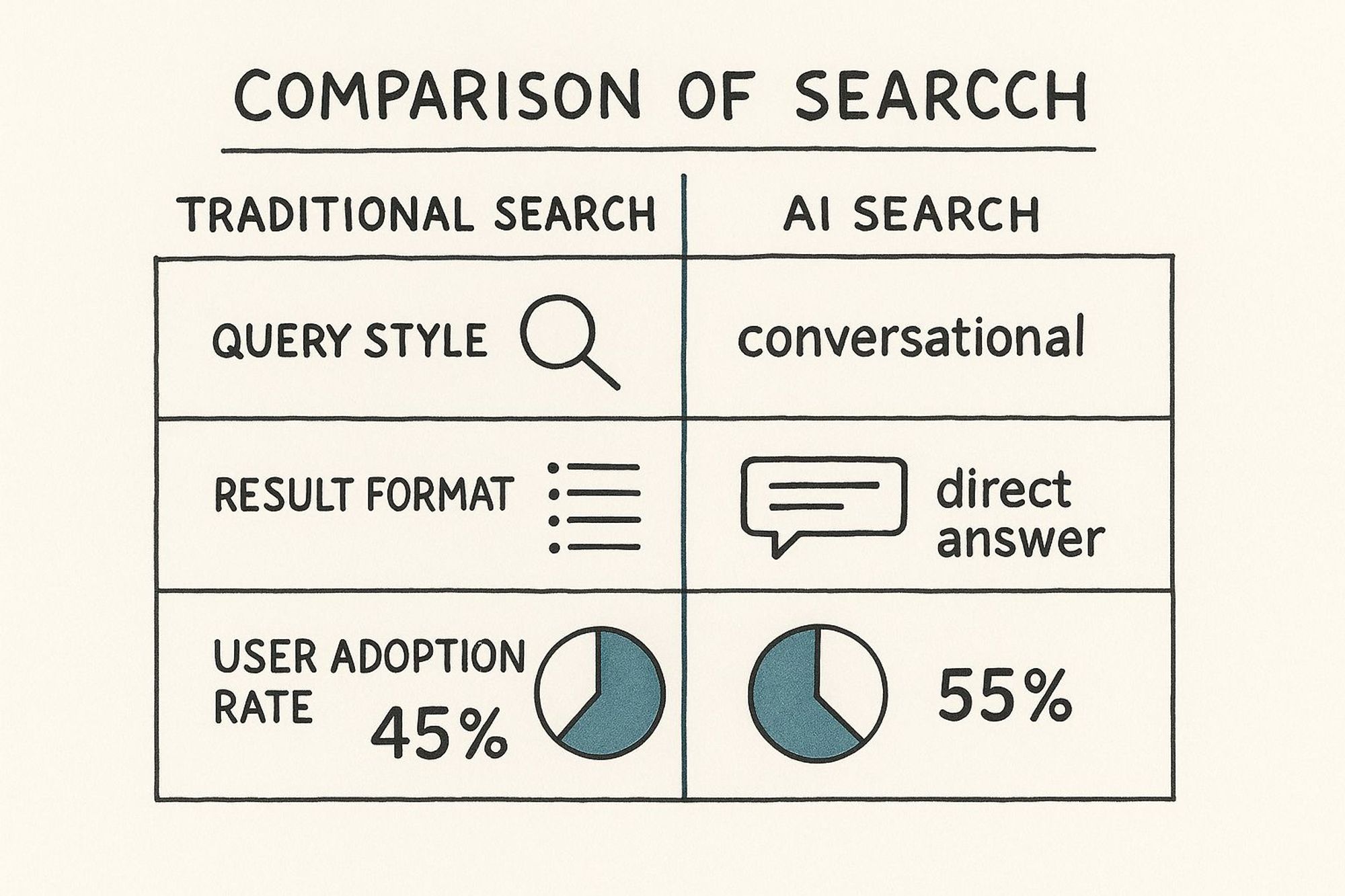
As you can see, success now depends on moving from a keyword focus to creating helpful, answer-first content. Getting mentioned by an AI is the new top spot on Google. To make this even clearer, let's compare the two approaches.
Traditional SEO vs AI Search Optimization
Factor | Traditional SEO (Google) | AI Search Optimization (ChatGPT) |
|---|---|---|
How People Search | Keyword-based searches ("best running shoes") | Conversational questions ("What are the best running shoes for someone with flat feet?") |
What Content Works | Long articles, lists, using keywords | Clear, direct answers, short summaries, Q&A format |
How Success is Measured | Ranking position, clicks | Mentions, being included in a direct answer |
How to Build Trust | Links from other sites, website authority | Factual accuracy, showing expertise, citing data |
The table shows the big shift we're all making. While Google still cares about your website's overall authority, AI is looking for specific, correct answers to tricky questions.
Stay Ahead of the Game
Getting ready for this new world isn't as hard as it might sound. It all starts with understanding what AI values most.
For a deeper look, you should check out our guide on the most important ChatGPT ranking factors. The key is to act now. If you aren't showing up in these new AI-powered conversations, you risk becoming invisible to a large and growing audience. The good news? The goal hasn't changed. You still need to be the most helpful, clear, and trusted source of information you can be. The only difference is that now, your audience also includes smart AI models.
To easily track your rankings and get ideas to rank higher, you can use our AI Rank Tracker. It shows you exactly where you stand and gives you simple steps to improve.
Mastering the Basics of Modern SEO
Before you can rank in AI search, you need a strong foundation. Think of your website like a house. You can install a fancy new doorbell, but it’s useless if the foundation is cracked. It's the same with your online presence; the basic rules of good search engine optimization (SEO) are more important than ever.
AI chatbots like ChatGPT are smart, but they still rely on the same signals Google has used for years to figure out which websites are trustworthy. They look for quality, authority, and clarity. If your site is a disorganized mess, the AI will just move on.
If you're new to this, learning the basics is your first step. This guide on What Is Search Engine Optimization is a great place to start.
The Timeless Rules of Good SEO
Even with AI changing the game, some rules never get old. Your website has to be built on a solid framework that both people and search engines can easily understand. You don't need complicated code for this, only common-sense practices that show you're a quality source.
Here are the things your site absolutely needs:
- Helpful, Clear Content: Your content must answer real questions from your customers in simple language. If someone asks, "What are your business hours?" that answer should be easy to spot at a glance.
- A Fast, User-Friendly Website: Your site must load quickly. It needs to be easy to use on any device, especially phones. A slow or confusing website is a major red flag for both users and AI.
- Consistent Business Information: Your Name, Address, and Phone number (NAP) must be the same everywhere online. That includes your website, your Google Business Profile, and any other directory. Differences create doubt, and doubt kills trust.
Getting these basics right is the single most important first step. An AI is programmed to find the most reliable answer, and a well-maintained, professional website sends a massive signal of reliability.
Why Local SEO Is a Superpower for AI
For any local business, these basics are even more important. AI models are used all the time for "near me" searches, like "find a reliable plumber in Brooklyn." To even be considered, an AI needs to be 100% sure about your location, what you do, and your reputation.
This is where local SEO becomes your superpower. When you make sure all your online listings are accurate and you encourage customer reviews, you're giving the AI the exact kind of clear, structured data it loves. For a deeper dive, our guide on SEO content optimization offers some great tips for creating content that works for local search.
Good SEO basics create a great experience for your customers, and that’s exactly what the AI is looking for too. Once that foundation is in place, you can start tracking your performance and making improvements.
Creating Content That AI Chatbots Trust
If you want to show up in AI search, you have to start thinking like a chatbot. These systems are built to find the most direct, trustworthy answer to a user's question. Clear writing and demonstrated expertise count for more with them than clever marketing copy or industry jargon.
This means structuring your content so it’s incredibly easy for an AI to understand. It's less about stuffing in keywords and more about creating a resource that feels like a genuine, helpful conversation.
Answer Questions Directly
The biggest change you need to make is moving from general, topic-focused articles to content that gives a specific answer. Find the exact questions your customers are asking, and then build your content to provide clear, simple answers to them.
For example, instead of a general page called "Our Plumbing Services," break it down into sections that directly answer real-world questions like:
- How do I know if I have a leaky pipe?
- What are the signs of a clogged drain?
- Is it better to repair or replace my water heater?
This question-and-answer format is perfect for AI. It allows a chatbot to easily grab a piece of information and present it as the final answer. A great way to do this for many locations or services is by using the methods in our guide on what is programmatic SEO.
Write Like a Human Being
AI models learn from billions of examples of natural human language. Because of this, they are very good at spotting content that sounds robotic or is awkwardly stuffed with keywords. The best way to create content that an AI trusts is to simply write in a conversational, human tone.
Imagine you're explaining something to a customer in person. Use simple language, short sentences, and break up your text into small, easy-to-read paragraphs. This helps AI process your content and makes it much easier for your human readers to understand.
Show Your Expertise and Authority
An AI doesn't just look for any answer; it looks for a credible answer. You have to prove that you know what you're talking about.
An AI is far more likely to trust and cite a source that provides clear, verifiable information backed by data and expertise. Vague claims and unsupported statements get ignored almost immediately.
Here’s how you can build that trust:
- Cite good sources: When you mention data or statistics, link to trusted websites, studies, or industry reports.
- Provide clear data: Instead of saying a product is "high quality," explain that it has a 4.9-star rating from over 500 reviews.
- Be specific: Instead of claiming you offer "great service," describe what that means, like offering a "24/7 emergency response" or a "100% satisfaction guarantee."
AI-driven search will likely keep growing. If you create helpful, clear, and authoritative content, your brand can be the exact answer an AI is looking for.
How to Become an AI Favorite in Local Search
For any local business, getting a recommendation from an AI is the new digital word-of-mouth. It’s a huge deal. When someone asks a tool like ChatGPT for the "best pizza near me," you want your shop to be the first name it mentions. But to make that happen, you have to give the AI the right kind of clear, factual information.
AI models rely on clean, consistent data to figure out what you do, where you are, and when you're open. They need facts organized in a way a machine can easily read, and the basics of local SEO give them exactly that.

Speak the AI's Language with Structured Data
You don't need to be a coding expert to get this. Think of structured data as putting clear labels on your website’s information for the AI. It's like labeling your moving boxes, "Kitchen Supplies," "Bedroom Linens", so the movers know exactly what’s inside without opening every box.
On your website, this little bit of code tells AI models things like:
- "This is our business address."
- "These are our opening hours."
- "This is a customer review with a 5-star rating."
When your site has this kind of clear labeling, an AI can confidently pull that data and present it as a fact. Without it, the AI is left guessing, and it will almost always favor a competitor’s site that gives it a straight, clear answer.
Build Trust Through Genuine Customer Reviews
For both people and AI, reviews are one of the most powerful signals of trust. When an AI scans your Google Business Profile and sees dozens of recent, glowing reviews, it learns that you're a real, well-liked business worth recommending.
Detailed feedback is gold. A review that says, "The emergency plumbing service was incredibly fast and professional," gives the AI specific context it can use to recommend you for a search like "emergency plumber downtown." It’s much more useful than just "Great service!"
Make a habit of encouraging your happy customers to leave detailed reviews. The more positive, descriptive feedback you collect, the more data an AI has to work with, building a powerful case for why your business deserves the top spot.
Your Local AI Search Checklist
Improving your local presence is the first real step toward showing up in AI search results. It’s all about making your business as easy as possible for a machine to understand. A great way to do this is by creating specific pages for each service in each location. You can learn more about how to create effective local SEO landing pages in our detailed guide.
Ready to start? Here are the simple but important actions to take now:
- Claim and Optimize Your Listings: First, make sure your Google Business Profile and other local listings are completely filled out. Every piece of information must be accurate and, most importantly, the same everywhere it appears online.
- Encourage Detailed Reviews: Don't be shy. Actively ask your satisfied customers to share their experiences on major platforms like Google, Yelp, or industry-specific sites.
- Use Structured Data: Add simple "schema markup" code to your website. This is what clearly labels your address, hours, services, and reviews for search engines and AI.
These steps help you in traditional search and get your business ready to be the go-to recommendation in AI answers.
Tracking Your AI Rankings and Getting Actionable Insights
You can't improve what you don't measure. It’s an old saying, but it’s more true than ever when you’re figuring out how to rank in AI search results. There’s just one problem: how do you even know if ChatGPT or Gemini is recommending your business?
The hard truth is that most traditional rank trackers are completely blind to AI-generated answers.
This is a huge gap in the standard marketing toolkit. While you're keeping an eye on your Google rankings, a growing number of your potential customers are getting recommendations from AI, and you have no way of knowing if you're part of the conversation. It’s like trying to win a game without a scoreboard.
A Modern Tool for a Modern Challenge
To fix this, you need a tool built for this new reality. That's why we created the LPagery AI Rank Tracker. It’s designed to give you a clear, simple way to see exactly where you stand in the world of AI search.
The whole process is incredibly simple. Just paste in your website, choose the keywords that matter most to your business, and let the tool do the work.
This screenshot shows how the LPagery AI Rank Tracker provides clear, actionable insights into your AI search performance.
As you can see, the dashboard doesn't just show you data; it gives you direction. You get a clear picture of which real-world customer questions you're visible for and, just as importantly, which ones you're missing out on entirely.
From Data to Actionable Steps
Now, here's where the magic really happens. Our tool doesn’t just show you where you rank; it tells you how to rank higher.
Based on its analysis, the AI Rank Tracker writes real customer questions, the kind of natural questions people actually ask chatbots, and checks your visibility in five AI assistants every week. If it finds a gap, it gives you a simple, easy-to-understand action step to fix it.
Instead of burying you in complex SEO jargon, the tool provides clear instructions like, "Add your business hours to your homepage," or "Create a dedicated page for 'emergency plumbing services in Boston.'" This takes all the guesswork out of AI optimization.
You’ll get weekly updates showing your progress along with new recommendations to keep you moving up. It turns a confusing, invisible challenge into a clear, step-by-step plan for success. It’s no longer about hoping you get mentioned; it’s about having a clear strategy to make it happen.
For a broader view, see our comparison of the best AI rank tracker tools available today.
Your Top Questions About Ranking in AI Search, Answered
As we all get used to this new way of finding information, plenty of questions are bound to pop up. It's a big shift, and it’s natural to wonder what it all means for your business. We've gathered the most common questions we hear to give you clear, straightforward answers.
What’s the Single Most Important Factor for Ranking in AI Search?
It all comes down to clarity and trust.
More than anything else, AI models are designed to find and deliver content that’s easy to understand, directly answers a user’s question, and comes from a source that proves its expertise. So, the single most important factor is consistently producing helpful, well-structured content.
An AI is far more likely to recommend a business that clearly explains its services with specific, factual details. Vague marketing fluff gets ignored almost every time.
How Is AI SEO Different from Traditional SEO?
They share the same foundation, but the focus is different. Traditional SEO often targets specific keywords, aiming to get a page to rank for a particular search term. AI SEO, on the other hand, is more about answering the underlying intent behind those keywords.
Think of it this way:
- Traditional SEO: Optimizes for a keyword like "plumber Brooklyn."
- AI SEO: Optimizes for a conversational question like "Who is the most reliable emergency plumber in Brooklyn for a burst pipe?"
AI search is built for conversational language and direct answers. It also relies heavily on structured data that helps it understand what your information is about without any guesswork.
Can I Just Use My Existing SEO Strategy for AI Search?
Your current SEO strategy is an excellent starting point, but it needs a few tweaks to really compete. A solid foundation of good content and a technically sound website is still absolutely essential. You just need to adapt it for an AI-first world.
Start by reviewing your content. Is it written in a natural, conversational tone? Does it answer questions directly, or does it beat around the bush? You should also double-check that all your local business information and structured data are perfectly accurate and complete everywhere on the web.
How Long Does It Take to See Results from AI Optimization?
Results can vary, but it's often quicker than you might think. We’ve seen businesses start to notice initial improvements within a few weeks of making simple, targeted changes.
Actions like updating your website copy to be more direct or ensuring your Google Business Profile is fully filled out can have a surprisingly fast impact. Of course, consistent effort over time leads to more significant and lasting results as AI models learn to trust your site as an authoritative source.
The key takeaway is that Google, while still the giant, is starting to face real competition. Even a small dip in its massive market share signals that user habits are changing.
While Google continues to dominate the search engine market with a 90.38% share, that number has seen a slight but notable decline from previous years. This small drop shows that AI-powered platforms are gaining ground. For more details on these trends, you can explore the latest search engine market share data on Statcounter.
I've worked in SEO for more than ten years and helped over 100 businesses rank higher, mostly local businesses, e-commerce stores and SaaS companies. As co-founder of LPagery I work on local SEO, programmatic SEO and AI search visibility, and I test the strategies in these articles on our own sites and with our customers.
I've worked in SEO for more than ten years and helped over 100 businesses rank higher, mostly local businesses, e-commerce stores and SaaS companies. As co-founder of LPagery I work on local SEO, programmatic SEO and AI search visibility, and I test the strategies in these articles on our own sites and with our customers.