How to Appear in ChatGPT Answers and Boost Your Online Presence

Part of the guide: Get your business recommended by ChatGPT, Gemini and Perplexity

Want to see your brand pop up in ChatGPT's answers? The secret isn't a complicated trick. It’s all about creating great, helpful content and being mentioned enough online that AI models start to notice you.
Think of it like building a good reputation. If enough trusted people say you're an expert, others will start to believe it. AI works in a similar way, it learns from what people are saying online.
Why Appearing in AI Answers Is Your New Big Goal

Imagine your perfect customer asks ChatGPT for a recommendation, and it suggests your brand. This isn't a dream; it's how search is changing. People are getting tired of looking through a long list of links on Google. They want one, clear answer, and they're using AI chatbots to get it.
This change is a huge opportunity. When an AI mentions your website, you get visitors and a strong sign of approval that makes you look like an expert in your field.
The Good Things About Being Seen by AI
Getting your content mentioned by tools like ChatGPT has some real benefits. Beyond the quick marketing win, it builds trust that lasts.
Here’s why you should pay attention to this:
- Builds Trust: When an AI mentions you, it’s like a stamp of approval. It shows people that your information is so good, even a smart AI trusts it. This helps people trust you right away.
- Gets You Great Visitors: People who click from an AI answer aren't just looking around. They want specific, deep information. This means they are often great potential customers who are ready to act.
- Makes Your Brand Look Good: When you show up in AI answers again and again, your brand becomes known as the expert. Over time, people will connect your name with helpful and correct information.
Becoming a trusted source for AI isn't just a new idea, it's the next step in online marketing. To stay ahead, you need a plan for creating content that AI can easily find and understand.
How to Get Started with AI Mentions
So, where do you start? The first step is to remember that AI tools learn by reading a huge amount of online content. Your job is to make your content a key part of that online library.
This means you need to write clear, factual, and well-organized articles that get straight to the point. For example, if you sell hiking gear, you should have a page that directly answers questions like "what are the best waterproof hiking shoes for rocky trails?" in a simple, helpful way.
Of course, you can't get better if you don't track your progress. You need to know if what you're doing is working. A good ChatGPT mentions tracker can show you what’s working and help you improve your plan.
By creating amazing content and watching how often you are seen, you can turn AI chat into a powerful new tool for your business's growth.
How ChatGPT Really Finds Its Information
To get your content mentioned, you first need to understand how ChatGPT actually works. Many people think it searches the live internet for every answer, like a Google search. The truth is a bit different, and knowing this will help you focus your efforts in the right place.
ChatGPT doesn't "search" like Google does. Instead, it uses a huge library of information that it was trained on. Imagine a person who has read millions of books and websites. When you ask a question, they answer from memory without searching the web in that moment.
This "library" is like a snapshot of the internet from a certain time, mixed with a large collection of licensed data, books, and other quality text. It isn't always being updated.
The Two Information Sources
So where does all this information come from? It’s a mix of two main things: its fixed training data and, for some questions, live web results.
- Training Data: This is the foundation of its knowledge. It’s a massive collection of text from websites, digital books, and trusted sources like encyclopedias and research papers. If your content was part of this collection when it was made, the AI already "knows" you.
- Live Web Browsing: For certain types of questions, especially about recent events or popular topics, newer versions of ChatGPT can do a limited search using Bing. This doesn't happen for every question, but it’s used to find information it doesn't already have.
Understanding this difference is very important. Your main goal is to create content that is so good and respected that it gets included in future training updates and is seen as a top source during those limited live searches.
What matters to these large AI models isn't just links, but mentions and context. The AI learns by seeing which brands, ideas, and facts often appear together across all its training information.
What Makes Information Trustworthy to an AI?
ChatGPT is built to prefer information that it thinks is reliable. It looks for signs that show authority and trust. For example, information that appears on many well-known websites is given more importance.
This means a statistic mentioned on one small, unknown blog is far less likely to be used than a fact that is mentioned by major news sites, university websites, and well-known industry experts.
This is why just having a website isn't enough. You have to build a reputation that makes your content a go-to source in your area. If you want to learn more about what AI looks for, we’ve explained the key ChatGPT ranking factors that affect its answers.
Besides making your content great, it’s also smart to think about how people actually use these tools. Many users now use tools like speech-to-text input for ChatGPT. This chat-like way of asking questions changes the kinds of answers the AI gives. By creating clear, direct, and conversational content yourself, you make your information a much better fit for how the AI finds and gives its answers.
How to Create Great Content That AI Models Trust

AI models like ChatGPT are made to find and share reliable information. Think of it like a librarian recommending a trusted book, the AI prefers sources that are full of expert knowledge. To get your brand mentioned, your content needs to become that go-to book on the digital shelf.
Aim to become the clear expert in one specific area. When you focus your content, you build a reputation for being an authority that both people and AI can easily see.
Go Deep: Focus on a Specific Niche
Let's say you run a pet store. Writing a general article like "Tips for Pet Owners" is just adding to the noise. It’s been done a million times.
Instead, what if you created a very detailed guide on "Caring for Senior Golden Retrievers"? Or a deep dive into the "Best Aquarium Setups for Betta Fish"? This sharp focus tells an AI right away that you’re an expert on those very specific topics.
When your website becomes a deep source of information on one subject, you become a specialist. That makes your content far more likely to be used when someone asks a related question.
Write Clear, Fact-Based Articles
AI models are trained on clear, simple language. Your goal is to write content that gets straight to the point without extra fluff. Imagine you're answering a question for a friend, you wouldn’t use complicated words or hide the answer in a long paragraph. You’d just give them the information.
Here are a few quick tips to make your content more AI-friendly:
- Use Simple Language: Avoid industry-specific terms and long, complex sentences. Write so that a complete beginner can understand the topic.
- Answer Questions Directly: Shape your content around giving direct answers. Use headings and subheadings that sound like questions real people would ask.
- Back Up Your Claims: When you state a fact, link to a trusted source. This is a huge sign of trust for an AI, showing that your information is well-researched.
AI models are always scanning the web, and they prefer content that's factual, well-organized, and easy to read. The clearer and more direct your writing is, the better your chances of being used as a source.
Organize Your Content for Easy Reading
How your content is laid out is just as important as what you’re saying. A huge block of text is hard for anyone to read, including an AI trying to process information quickly. Breaking your content into smaller chunks with clear headings makes it much easier to understand.
Think about the huge number of people you’re trying to reach. As of late 2025, ChatGPT has around 800 million weekly active users from all over the world, including the United States, India, and Brazil. This massive global audience asks questions in countless different ways, making clean, well-organized content essential for the AI to understand and use.
Good organization is also just good for SEO. It helps your overall SEO content optimization, which helps you rank better in regular search engines, too. To see how this works in the real world, check out how some businesses are already using these AI strategies in digital marketing.
When you make your content both trustworthy and easy to read, you build a strong foundation for appearing in ChatGPT's answers.
Using Structured Data to Speak AI's Language
While clear, human-friendly content is key, you also need to make sure your site is easy for computers to read. That's a huge part of the puzzle for getting mentioned in ChatGPT answers.
This is where structured data, also known as Schema markup, comes in. Think of it as adding special labels to your website's code that clearly tell AI and search engines what each piece of content is about.
These labels remove any guesswork. Instead of an AI trying to figure out that "Jane Doe" is the author of an article, you can use a specific tag that says, "Hey, this is the author's name." That kind of clarity is very valuable for an AI model trying to process information correctly.
Why AI Loves Clear Labels
Structured data basically turns your content from a messy block of text into a perfectly organized digital file cabinet. AI models can instantly pull out specific details, like your business address, an event date, or a product price, without having to guess.
This simple step makes your website a much more reliable source in the AI's eyes.
For example, when an AI model scans a recipe page, structured data can clearly label the cooking time as "45 minutes" and the calorie count as "350 calories." This is exactly the kind of clear information the AI needs to give direct, factual answers to user questions.
Common Types of Structured Data to Use
You don't need to be a coding expert to start using structured data. A few specific types of Schema markup are perfect for helping AI understand the most common kinds of content.
Here are a few of the most useful ones:
- Article Schema: This labels the key parts of your blog posts, like the headline, author, and publication date. It helps show your content is a properly formatted, trustworthy source of information.
- FAQ Schema: This one is perfect for any Q&A pages. It clearly marks a question and its answer, directly feeding AI models the kind of chat-like content they need to answer user questions.
- Local Business Schema: A must-have for any business with a physical location. It clearly states your business name, address, phone number, and hours, making it easy for an AI to recommend you for local searches. You can learn more about this in our guide to local business Schema.
Using structured data is like giving an AI a cheat sheet for your website. You’re not trying to trick it; you’re just making it easier for the AI to understand the facts, which greatly increases its trust in your content.
This approach is getting more important every day, especially in certain industries. By late 2025, ChatGPT was already helping with purchases in areas like travel (18%), retail (16%), and IT services (14%). Brands in these fields that provide clearly labeled data are much more likely to be mentioned. You can see more on ChatGPT's impact on business over at firstpagesage.com.
To make it even easier, here's a quick guide for choosing the right structured data to help AI understand your content.
Key Content Types and Their Best Schema Markup
Content Type | Recommended Schema Markup | Why It Helps AI |
|---|---|---|
Blog Posts & Guides | Article, HowTo | Clearly defines the author, date, and steps, marking it as a credible source. |
Q&A Sections | FAQPage | Provides direct question-and-answer pairs, perfect for conversational AI. |
Product Listings | Product | Labels price, availability, and reviews, making it easy for AI to cite details. |
Local Business Info | LocalBusiness | Specifies address, hours, and phone, making you a reliable local suggestion. |
Recipes | Recipe | Highlights ingredients, cook time, and nutrition, ideal for direct answers. |
Events | Event | Pinpoints date, time, and location, helping AI provide accurate event info. |
Choosing the right schema is a simple but powerful way to translate your content into a language AI models can instantly trust and use.
Scaling Your Content to Boost AI Visibility
Creating one great article is a good start, but if you really want to get noticed by AI models like ChatGPT, you need to think much bigger. The secret is to create a huge library of helpful, specific content. This greatly increases the chances that an AI will see your site as a complete resource worth mentioning.
This is where a strategy like Programmatic SEO becomes so useful. It’s a way to create hundreds, or even thousands, of pages that each answer a very specific question. Think about all the very specific questions people ask AI, like questions about a service in a certain town or a product for a special use.
Instead of one broad page, you’re creating an army of focused ones. This method builds a deep, connected web of information that makes your site look like an authority on a massive scale. To really understand the basics, you can check out our detailed guide on what Programmatic SEO is.
Answering Every Possible Question
The main idea here is to cover your topic from every possible angle. Let's say you run a moving company. Instead of a single "services" page, you could create separate pages for "moving services in [City Name]" for every city you work in. Each page gives a super-focused answer, making your site a goldmine of relevant information for AI models.
This large amount of focused content does two key things:
- Increases Your Chances: More pages mean more opportunities. You have far more chances for your content to be included in the data AI models are trained on.
- Builds Topical Authority: When you have hundreds of pages all about one main topic, you’re sending a clear signal to both AI and regular search engines that you are the expert.
Think of it like building a complete encyclopedia for your industry. The more detailed and specific pages you have, the more likely you are to be the source an AI turns to for a correct answer.
The Power of Frequent User Questions
The amount of interaction people have with AI is huge, and it directly shapes what the models learn. For example, by mid-2025, ChatGPT users were sending over 2.6 billion messages every day. This constant feedback helps the model improve its answers, and the topics that come up most often are more likely to be featured. You can find more information on this traffic over at forklightning.substack.com.
This process flow shows a simple way to set your goals, create specific questions, and check the AI's answer, a key cycle for understanding what kind of content works best.
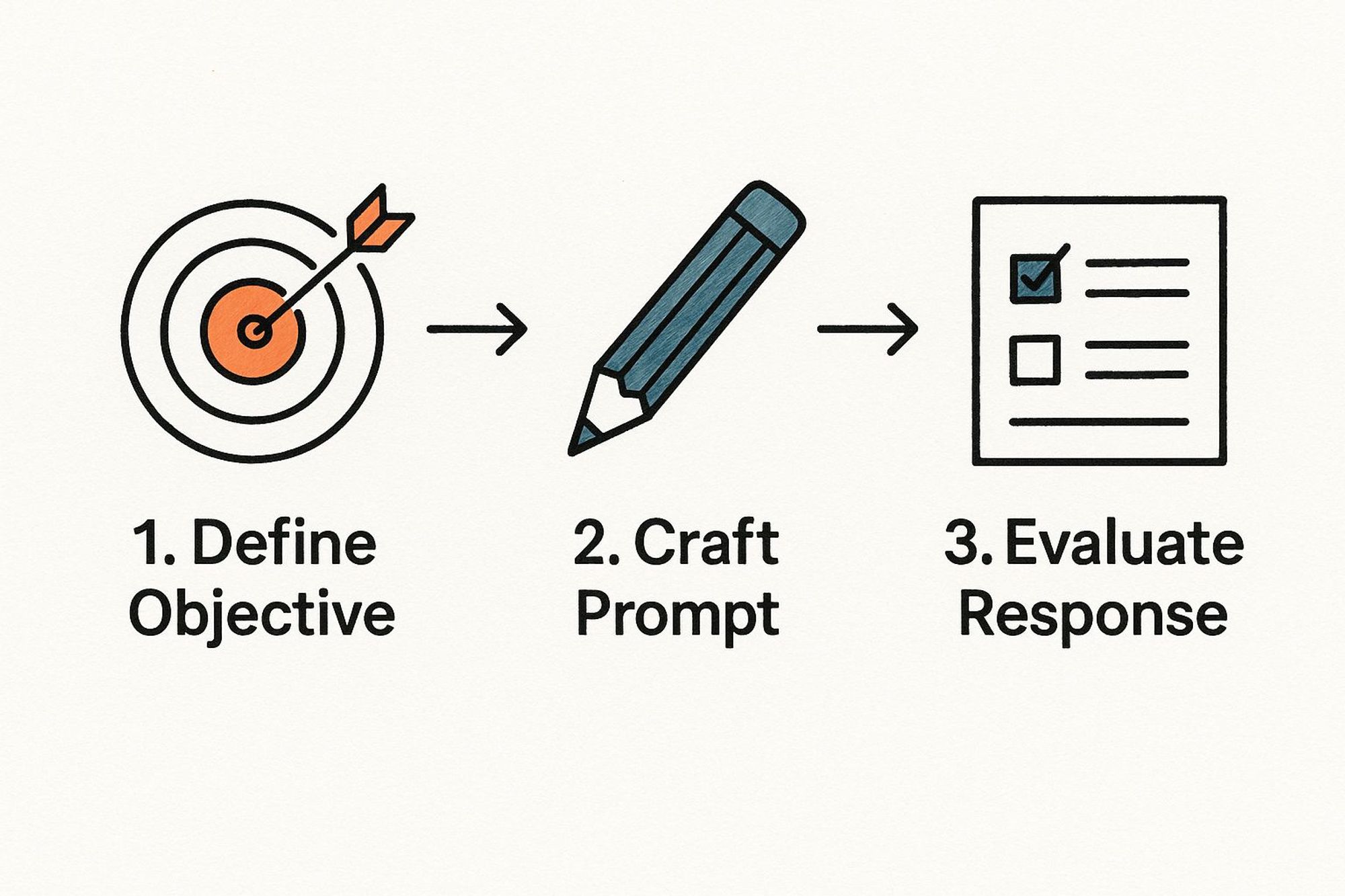
The main point is simple: by creating pages that answer these common, specific questions, you’re matching your content directly with the data that models use for learning. Your scaled content becomes part of the conversation, which is exactly how you increase your chances of appearing in ChatGPT's answers.
Common Questions About Getting Cited by AI
Even with a good plan, you probably still have a few questions. This is a new world, after all. Let's go over some of the most common ones I hear to help you know what to expect and improve your plan.
Can I Just Submit My Website to OpenAI?
This question comes up a lot, and the short answer is no. You can't just send your site directly to OpenAI to be included in ChatGPT’s training data.
Think of it less like sending a sitemap to Google and more like building a real-world reputation. The goal is to make your content so good and respected that it naturally gets included in future data updates. Your content needs to be part of the public web conversation that these models are trained on.
How Long Does It Take to See Results?
Patience is very important here. Getting your brand mentioned by AI is a long-term goal. It could take several months, or even longer, for your work to pay off. Two main things affect the timing.
- Training Data Updates: AI models are not always learning from the web in real-time. Their main knowledge is based on huge datasets that are only updated from time to time. It can take a while for the great content you publish today to be included in a future update.
- Live Search Citations: For models that can browse the live web, you might see results much faster. If your content is already ranking well in search engines for specific questions, the AI can find and mention it right away.
The real secret is to be consistent. Every piece of high-quality, trustworthy content you publish is a building block. You're not looking for a single quick success; you're building a reputation one step at a time.
Does a Paid ChatGPT Subscription Change the Answers?
A paid subscription like ChatGPT Plus won't give your content any special treatment or change the model's basic answers.
The subscription is all about the user's experience, it gives people faster responses, first access to new features, and the ability to use newer models. But it doesn’t change the core information the AI uses.
Your strategy should be the same whether the person using it is on a free or paid plan. Focus on becoming a clear source of truth on the web, and the rest will follow.
I've worked in SEO for more than ten years and helped over 100 businesses rank higher, mostly local businesses, e-commerce stores and SaaS companies. As co-founder of LPagery I work on local SEO, programmatic SEO and AI search visibility, and I test the strategies in these articles on our own sites and with our customers.
I've worked in SEO for more than ten years and helped over 100 businesses rank higher, mostly local businesses, e-commerce stores and SaaS companies. As co-founder of LPagery I work on local SEO, programmatic SEO and AI search visibility, and I test the strategies in these articles on our own sites and with our customers.