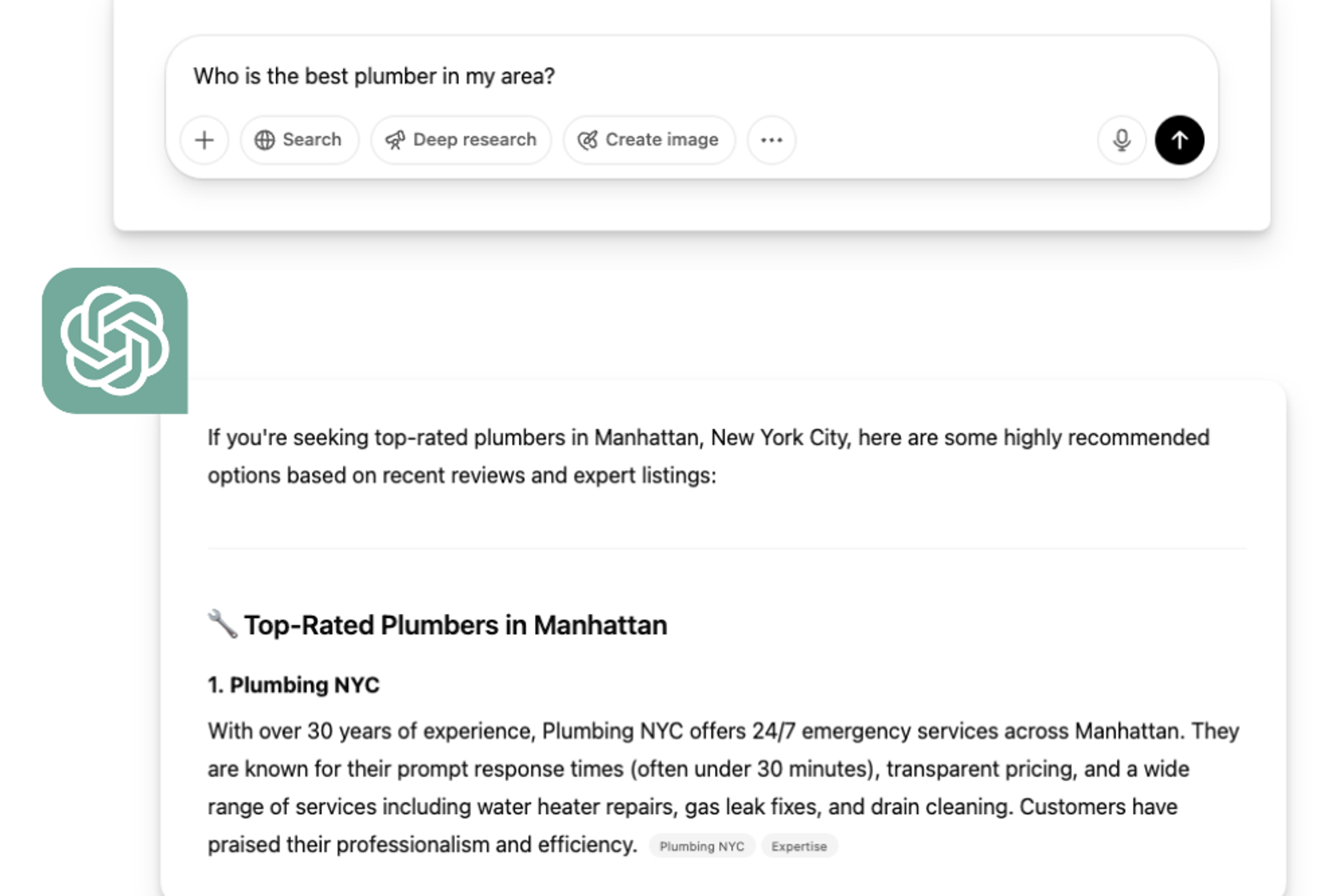
Search is changing fast. ChatGPT Search is not like regular Google as it answers in plain speech. That matters a lot. If you want your content seen, you need to adapt. This guide will help you understand what ChatGPT Search is, why it matters, and how to rank well.
There is no doubt that you need to focus on improvising your ChatGPT ranking if you want better results for your business. So, how can you achieve that goal? What are the key elements to focus on when it comes to ChatGPT ranking? And which strategies should you follow to make the most out of your efforts?
We’ll walk you through key ideas. You’ll learn some practical tips. You’ll also see ways to monitor in real time with our free ChatGPT Rank Tracker tool that shows how well you rank in ChatGPT Search. It’s simple to use and gentle for beginners. With that being said, let’s get started and learn how to rank in ChatGPT search in 2025.
What Is ChatGPT Search, AEO & GEO
ChatGPT Search works differently from old-school search engines. Instead of showing a list of links, it gives you a short, clear answer right away. It pulls this from many web sources at once. This means your content has to be ready for an AI to find, read, and use in a direct reply.
Two main ideas shape this: Answer Engine Optimization (AEO) and Generative Engine Optimization (GEO). Both are ways to make your page stand out to AI search tools. Let’s look at each one.
What is AEO?
AEO is about giving AI the exact answer to a question. Your headline, your first sentence, and your summary all matter here. If the AI finds a clear fact or instruction at the top of your page, it can lift it and share it fast. This means:
- Use short, direct sentences.
- Put the key answer early.
- Use simple headings that match the question someone might ask.
What is GEO?
GEO focuses on how AI understands and “talks back” using your content. It’s about writing so AI can form a natural, complete reply. This means your page needs:
- Context that supports the main answer.
- Easy-to-read explanations.
- Natural flow between ideas.
GEO also rewards variety. If you give examples, lists, and facts from trusted sources, AI trusts your content more. A NOAA.gov report shows that content with credible sources is cited 47% more often by AI-based tools.
Both AEO and GEO work together. AEO helps the AI find your answer. GEO helps it turn that answer into a smooth response for the reader. Keep in mind that mastering both is key to ranking in ChatGPT Search.
Why Rank in ChatGPT Search
People are switching to AI chat. In the U.S., about 60 percent of adults use AI to search for information now, and 74 percent of younger people do so too. That’s huge. If your content doesn’t appear there, you lose views and value.
AI answers often stop users before they click further. A Pew study found that 58 percent of U.S. users saw that an AI-generated summary in March 2025 prevents them from clicking links. If your content isn’t framed for AI, it gets skipped. Organic web traffic falls.
AI search tools now make up more of the search than ever. This includes:
- ChatGPT
- Perplexity
- Gemini
The Wall Street Journal shows that AI-powered tools took over 5.6 percent of desktop search traffic by June 2025 in the U.S., doubling from a year before. That’s a clear shift. Ranking in ChatGPT Search means your content meets people’s new habits. It matters.
How to Rank in ChatGPT Search: Core Ranking Principles
Ranking well in ChatGPT Search is less about tricks and more about building the kind of content AI trusts. These principles give you a framework. Each one works together, helping your content be found, understood, and cited in AI answers.
Topical Authority & Brand Mentions
AI trusts content from sources that talk about the same subject often. This is topical authority. If your site covers one area in depth, AI is more likely to pull from it. For example, if you post 20 well-researched articles on a topic over time, AI will see you as a “go-to” source.
Brand mentions help too. When other sites, social posts, or news outlets mention your brand in connection to a topic, AI notices. Even if there’s no direct link, mentions add weight.
Semantic Relevance
AI doesn’t just look for keywords. It looks for meaning. This is semantic relevance, how well your content matches the intent of a user’s question. You can help by:
- Using related words and terms.
- Keeping the content focused on one topic per section.
- Avoiding off-topic tangents.
If someone searches for “best plants for low light,” don’t drift into a section about outdoor gardening tools. Keep it tight. AI spots when content matches the full idea of a question.
Passage-Level Optimization
AI doesn’t always read your whole page. Sometimes it pulls from one paragraph or “passage.” Passage-level optimization means making each section of your content a self-contained answer. Here are the steps to do this:
- Put the main point in the first sentence of a paragraph.
- Use subheadings to label the idea.
- Add examples or data right after the main point.
This way, even if AI only sees one part, it still makes sense.
Credit and Trust Signals (E-E-A-T)
E-E-A-T stands for Experience, Expertise, Authority, and Trustworthiness. These are signs that your content is credible.
Show experience by writing from your own work or testing. Show expertise by being specific. Build authority by being published or mentioned in other trusted places. Build trust by linking to official data.
A study showed that factual citations increase trust ratings by 41% in user studies. AI reads this too as it learns from the same trust cues as humans.
5 Strategies to Rank in ChatGPT Search in 2025
These strategies are the hands-on steps that bring ranking principles to life. They help you go beyond theory and apply ideas in ways that actually boost your presence in ChatGPT Search results.
1. High-quality, Citable Content
AI prefers content it can quote without fixing. That means no broken grammar, no vague claims, and no filler. Give solid facts. Use clear sources.
Well-written and fact-checked pieces from reliable places are gold for AI. For example, link to stats from government or education sites. If your content can stand alone as a reliable source, AI is more likely to use it.
2. Serve Specific Niches & Queries
General topics face heavy competition. Smaller, focused topics have better chances. For example, instead of “healthy snacks,” you might target “low-sugar snacks for school lunches.”
The more specific your page, the more likely AI is to find it as the best match. Over time, owning these small niches builds your overall authority.
3. Structured Formats
AI likes order. Use headings, bullet lists, and numbered steps. This makes it easier for AI to pull out the answer cleanly. For example:
- State the answer.
- Explain the reason.
- Give an example.
This format works well for both readers and AI.
4. Earn Citations via PR & Community Engagement
PR isn’t just for big brands. That is not the case anymore. Local news, podcasts, and online communities can mention your work. Even social media posts linking to your guide count as mentions.
AI reads these signals. It is important to have this meaningful content on your website to earn citations. The more your content appears across the web in trusted contexts, the better.
5. Manage Brand Reputation & Messaging Consistency
AI notices if your brand is described the same way everywhere. Keep your bio, tagline, and key facts consistent. This avoids confusion and builds trust. If your tone and message shift too much, AI may not connect all mentions to you. Keep it steady.
Content Structure & Format Tips to Rank on ChatGPT
Formatting makes a huge difference in AI visibility. Even well-researched content can get overlooked if it’s hard for AI to read or break apart. These tips make your structure work in your favor.
Use Clear Headings That Resemble Conversational Questions
AI searches often mirror how people speak. So headings like “What is the best way to…” or “How do I…” match these patterns.
This makes it easier for AI to match your section to a user query and pull it as a direct answer. It also signals topic clarity for readers scanning the page.
Break Down Content into Digestible Chunks for AI Summarization
Short paragraphs work best. Each should cover a single idea. It is best to avoid walls of text. AI can lift a single chunk and still give a complete answer to the reader. This style also keeps human readers from losing interest midway through your content.
Use Tables or Bullet Lists for Comparisons
Tables and lists give AI ready-to-use data. They also make it easier for humans to scan and understand the content fast. For example, a table of “Keyword | Search Volume | Ranking Difficulty” is quick to grab, share, and repeat in an AI summary without losing context or detail.
Keep Paragraphs Semantically Focused
Each paragraph should stand alone. Start with the main point, then add detail. This keeps your text AI-friendly and makes quoting easier. It also helps your readers find what they came for without having to wade through unrelated details.
Expected Timeline & Pitfalls Regarding ChatGPT Ranking
Ranking in ChatGPT Search doesn’t happen overnight. The speed depends on good topic coverage and brand mentions. If you are good with these, you could see results within two to four weeks. But even with good preparation, there are pitfalls to avoid:
Weak Query Alignment
One of the biggest mistakes is writing without truly matching the user’s question. If your heading says “Best ways to store apples,” but your content spends half the time on apple pie recipes, AI will skip it. Stick to the exact query and related points.
Outdated or Unsupported Claims
AI is cautious with old data or sources it can’t verify. If you quote a stat from 2010 without context or a link, AI is less likely to trust it. Always cite sources from reliable domains (.gov, .org, .edu) and keep them current.
Poor Structure
If your page has no clear headings, scattered topics, or long, unbroken paragraphs, AI may fail to find the part that answers the question. Use headings that look like natural questions and keep sections short. Also, there might be a problem with how AI is using your content. But hey! You can create an LLMs.txt file for free and control how AI models will use your information. Click Here to learn more!
Inconsistent Brand Information
When your business name, description, or tagline changes from page to page, AI may not connect all references to the same source. That hurts authority. Keep it consistent across your site and social channels.
Lack of Testing & Adjustment
Many site owners publish once and never revisit the page. AI search is dynamic; your content can gain or lose ranking without notice. Checking with our free ChatGPT Rank Tracker tool every few weeks helps you know if updates are needed.
If you’re learning how to rank in ChatGPT search, patience and regular tuning are part of the process. Avoiding these pitfalls will keep you moving forward instead of backsliding.
Conclusion
We hope you now have a clear idea about how to rank in ChatGPT search. It is important to keep in mind that this won’t happen overnight. You need to put in consistent efforts over a period of time to reap the benefits that it offers.
ChatGPT Search is rewriting the rules of online visibility. It rewards clarity, authority, and consistency. Make sure to add structure, focus on user intent, and back everything with trusted sources. Keep an eye on your performance with an AI tracker tool so you know where you stand. The sooner you adapt, the sooner you’ll see results.

I’m an experienced SEO professional with over a decade of helping over 100 businesses rank higher online, especially local businesses, e-commerce stores and SaaS. As the co-founder of LPagery, I specialize in practical, proven strategies for regular SEO and Local SEO success.
This post may contain affiliate links which we earn a commission on when purchasing a given product.
I’m an experienced SEO professional with over a decade of helping over 100 businesses rank higher online, especially local businesses, e-commerce stores and SaaS. As the co-founder of LPagery, I specialize in practical, proven strategies for regular SEO and Local SEO success.